Modern Roads to Glory
A look back at the recent shots that delivered U.S. Open Championships.
By Shaun Tolson


Seven years have passed since Shinnecock Hills last hosted the U.S. Open, and in that time, golf fans have been treated to captivating storylines, ample drama, and plenty of memorable shots. In celebration of the major’s return to Shinnecock—and to drum up even more excitement for the country’s most prestigious golf tournament—we’re taking a closer look at the pivotal shots that won each of the last seven U.S. Opens. (Spoiler alert: more than half occurred before the final hole.)

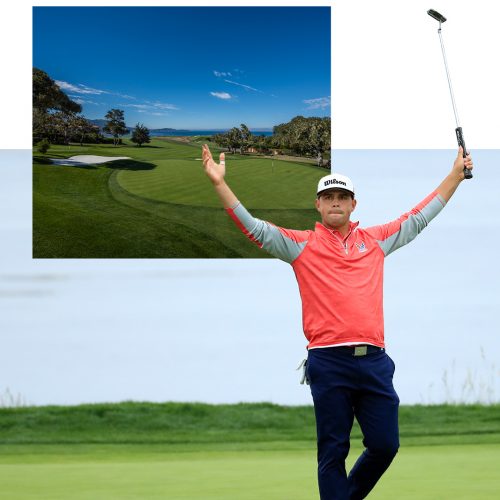
2019
Gary Woodland’s approach shot on the 14th hole
During the 119th U.S. Open at Pebble Beach, Gary Woodland held a two-stroke lead after the second round and a one-stroke lead when play concluded on Saturday. His final round started strong with birdies on holes two and three, but Woodland was also struggling with his driver. By the time he reached the first par-5 on the back nine (No. 14), he was narrowly ahead of Brooks Koepka, playing in the group ahead.
Pebble’s deep rough sabotaged Koepka’s chances of posting a low score on the hole, whereas Woodland hit an exceptional drive and was playing his second shot from the left center of the fairway. The Kansas native was intent on taking advantage of the opportunity. With a 3-wood in his hands, Woodland took dead aim at the flagstick, which was tucked on the left side of the green 263 yards away and guarded by a deep, front bunker. In brisk conditions, Woodland’s shot flew the bunker, landing on the front edge of the green complex and bounding to a rest just on the edge of the rough and just past pin high. It ultimately set him up with a birdie, which gave Woodland a two-stroke lead that he never surrendered.
2020
Bryson DeChambeau’s wedge from the rough on the fourth hole
Leading up to the 120th U.S. Open, much of the talk centered on how a classic, Golden Age course like Winged Foot could stymie the likes of the PGA Tour’s longest hitters. More specifically, these prognostications focused on Bryson DeChambeau, given that the 2015 U.S. Amateur champion had recently emerged with a lot more muscle, a faster swing speed, and even longer drives.
The fourth hole of the final round not only answered that question but effectively told the tournament’s story. With his drive, DeChambeau challenged the bunker at the inner elbow of the 467-yard, dogleg-left par-4, easily carrying it with a tee shot that flew 305 yards but ended up in the course’s deep rough—albeit with a good angle into the green. From there, DeChambeau’s strength took over, and he muscled his second from out of the rough. Moreover, his wedge play was a thing of beauty—a punchy recovery shot with a sawed-off finish that landed well short of the green, bounced a handful of times on the fairway, and rolled up pin high left of the flag. The approach gave him an easy putt up the hill, which he converted for a birdie. After the fourth, DeChambeau was tied with his playing partner, Matthew Wolff, but that birdie gave him the momentum to eventually run away with the championship.

2021
Jon Rahm’s birdie putt on the 17th hole
Much will be made of Jon Rahm’s putt on the final hole of the 121st U.S. Open at Torrey Pines, since it effectively won him the title; however, it’s the putt that he made on the 71st hole that stands out most to us. The downhill putt broke several feet to Rahm’s right; and when it dropped, the Spaniard was temporarily propelled into a tie for the lead with Louis Oosthuizen, who was playing in the final group just behind Rahm. By the time the final group had finished the 17th hole, Rahm was the leader by a single stroke; and even though Oosthuizen birdied the 18th, it was too little, too late. Rahm birdied the final hole, too, and he did it holing another left-to-right breaking putt. It’s hard not to think that his birdie on the 17th contributed to his confidence to read and sink that trophy-raising final stroke.
2022
Matt Fitzpatrick’s fairway-bunker shot on the final hole
Paul Azinger boldly (and rightly) proclaimed, “What a mistake!” when Fitzpatrick over-drew his drive on the 18th hole at the Country Club in Brookline, Mass., during the 122nd U.S. Open. It left the Brit with a challenging, 160-yard fairway bunker shot influenced by high-grass lips and played to a well-guarded, slightly elevated green. Only moments before, Azinger explained, “You just have to avoid the left bunkers at all cost.”
That was perhaps even more true for Fitzpatrick, who—in his own words—had struggled to consistently hit crisp fairway bunker shots all year. Fortunately for Fitzpatrick, he had a line to the green that avoided the lip of shaggy grass on the island in the middle of the bunker. And, as Fitzpatrick recalls, he hit a purely struck 9-iron that cut as much as 12 yards to the right, finishing 18 feet behind the flagstick. A two-putt par secured him of his first major title, but it’s the fairway bunker shot just before that will live on as one of the most clutch shots of the championship.


2023
Wyndham Clark’s fairway wood on the 14th hole
Wyndham Clark wasn’t on many people’s radars coming into the 123rd U.S. Open at Los Angeles Country Club. Over his previous four full seasons, the Denver native had logged nine top 10s—including a playoff loss to Brian Gay in the Bermuda Championship in 2020. While many within the game acknowledged that Clark had all the tools to win at the highest level, he’d yet to put it all together.
The stars aligned in L.A. in 2023, when Clark was always at or in close pursuit of the lead. His final round opened in promising fashion, with birdies on three of the first six holes; but by the time he made the turn, Clark was only one up on Rory McIlroy, who was playing in the group ahead. That all changed on the 14th hole, when Clark hit a stunning 3-wood from 279 yards out, landing the ball just in front of the mouth of the green—an opening only 20 feet wide—through which the ball rolled and came to rest in comfortable two-putt territory for a game-changing birdie.
When Clark stepped on the 15th tee box, he had a three-stroke lead with only four holes to play. The cushion proved just enough to secure his first victory on tour, as Clark won the U.S. Open by a single shot over McIlroy.
2024
Bryson DeChambeau’s 55-yard bunker shot on the final hole
It’s unfortunate that Rory McIlroy’s missed putt on the 18th hole is likely what will be remembered most about the conclusion of the 124th U.S. Open at Pinehurst, and it’s disappointing for two reasons. For starters, the television broadcast made the Northern Irishman’s putt look much easier than it was, so McIlroy will forever be judged harshly for missing a putt that, in reality, was trickier than its length would indicate. Secondly, McIlroy’s miss is likely to forever overshadow Bryson DeChambeau’s remarkable scrambling par save.
Out of position off the tee, DeChambeau had to punch out from the native area well left of the fairway, navigating a tree limb with his backswing to advance his ball down near the green. His second shot found sand guarding the front-right portion of the putting surface and left a difficult 55-yard bunker shot. The 2020 U.S. Open champ deftly splashed his third out of the trap and nestled his ball below the hole only three feet away. In time, the world will only remember the putt McIlroy missed and the one DeChambeau made, but the latter’s success really stemmed from a remarkable up-and-down that began in the bunker short of the green.


2025
J.J. Spaun’s birdie putt on the final hole
There’s a general belief among golfers that bad bounces will inevitably be balanced by good breaks down the road. If you need proof, just watch a compilation of every televised shot hit by J.J. Spaun during the final round of the 125th U.S. Open at Oakmont Country Club. The PGA Tour journeyman entered Sunday just one stroke back, but a series of bad shots and bad breaks led to bogies on five of the opening six holes—none worse than on the second, when Spaun’s wedge into the green hit the flagstick on its first bounce and rolled some 40 yards away from the hole, leading to a bogey when a makeable birdie putt was likely in his future.
By the time Spaun reached the 18th hole, he clung to a one-shot lead; and by the time he reached the green, he needed a two-putt from almost 65 feet to win. If the golf gods were conspiring against him on the second hole, they were rewarding him for his resolve and resiliency on the 18th. Given the speed of Spaun’s first putt, had it not hit the flagstick, he likely would’ve been standing over a 3- or 4-foot knee-knocker to win the U.S. Open. Instead, Spaun hit a beautiful putt that broke toward the hole, hit the flagstick, and dropped for a birdie. (In full transparency, Spaun’s tee shot on the drivable 17th hole was likely the most pivotable in his comeback victory, but his birdie putt on the 18th will be the one forever etched in golf fans’ memories.)