Six All-Time
Masters Moments
The Masters—a tradition and a tournament unlike any other—produces indelible moments. Here, we present six of the most meaningful and memorable of the past 40 years.


Every year in April, the golfing world focuses its collective gaze on Georgia. It’s there in Augusta that the Masters—the world’s most famous (and most exclusive) invitational golf tournament, an event teeming with pomp and circumstance, and plenty of tradition—has been contested for more than 90 years.

During the golf season’s first major, when spring is always ready for its close-up at Augusta National Golf Club, memorable moments are plentiful. Every now and then, a monumental accomplishment takes place, too. In 1986, Jack Nicklaus became the oldest Masters champion, winning his sixth and final green jacket. It’s a record that has stood for nearly 40 years.
As a tip of the cap to the Golden Bear’s six green jackets and the 40th anniversary of that achievement, we’re celebrating the six greatest Masters moments of the past four decades.
From Grief to Glory
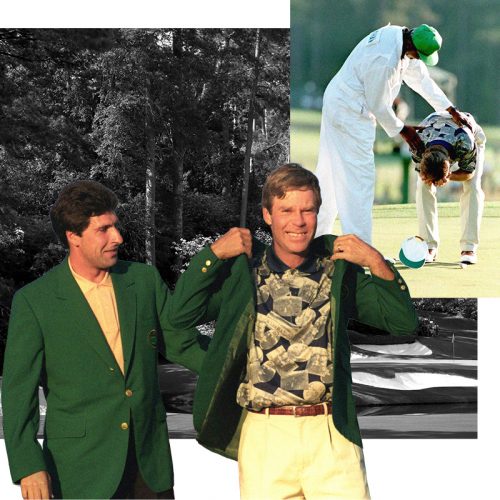
When Ben Crenshaw arrived at the Masters in 1995, 11 years had passed since he had claimed his first, and only, major championship (the Masters in 1984). A couple of years into his third decade as a touring professional, Gentle Ben was past his prime, at least by professional golfing standards. Of even greater significance, when he arrived at Augusta National that week, Crenshaw’s emotions were in shambles. His longtime coach, mentor, and friend, Harvey Penick, had died only four days earlier. “I came here to the Masters tournament lost, my game and my heart broken,” Crenshaw later said in a Masters-produced video dedicated to that year’s championship.
After the first round, Crenshaw was four strokes off the lead and tied for 16th, but by the end of day two, the affable Texan had cut the deficit to only two strokes and was tied for 4th. He was 10-under par and tied for the lead when moving day concluded. And on that fateful Sunday, as most of the players at the top of the leaderboard struggled, Crenshaw carded a 68. “I had a 15th club in the bag this week,” he told Jim Nantz during the jacket ceremony, “and that was Harvey.”
Tiger Attack
Tiger Woods arrived at Augusta National in 1997 with two prior appearances in the Masters under his belt. He tied for 41st in 1995 and missed the cut the following year. However, Woods was an amateur during those first two appearances. His participation in 1997 would mark his first as a pro. The first nine holes of the championship, however, were hardly a strong first impression. Jim Thorpe politely described Tiger’s game on those outward holes as “unsettled.” He was 4-over par. More notably, as witnesses have since recalled, Woods was furious as he walked off the ninth green and toward the 10th tee. His subsequent play on the back nine was what we can now describe as “vintage Tiger.”
Woods carded four pars, four birdies, and an eagle, returning in 30 strokes and finishing the first round 2-under-par and in fourth place. He followed that with a 6-under round on Friday, 7-under on Saturday, and 3-under on Sunday to post a then-record final score of 18-under for the tournament. The real statement was Woods’s margin of victory, 12 strokes, which remains a Masters record. And to think, he was 4-over after his first nine holes of the championship!


From Grief to Glory
As part of his exposition of the 16th hole during CBS’s final-round coverage in 2005, Verne Lundquist talked of the par 3’s evolution and its notable features during the broadcast’s flyover. “This kidney-shaped green that has been the scene of so many pivotal moments in Masters history,” the veteran broadcaster proclaimed as the camera focused in on the putting surface. When Chris DiMarco and Tiger Woods arrived at the tee box, with Woods holding onto a one-stroke lead, the brief slice of commentary seemed only that. In reality, it was expert (or perhaps accidental) foreshadowing.
After DiMarco hit his tee shot to about 15 feet, Woods uncharacteristically flew the green, hitting an 8-iron long and slightly left of the putting surface. The shot left him one of the most challenging chips the hole could deliver—one made even harder by the fact that his ball had nestled up to the edge of the second cut. As Woods focused on a landing spot high up on the slope and to the left of the flag, about 25 feet away from the hole, Lanny Wadkins chimed in from his perch in the tower alongside Lundquist. “There’s a good chance he doesn’t get this inside DiMarco’s ball.”
Instead, Woods hit a low, checking bump-and-run that seemed to grab hold of the turf just where Woods had been looking. From there, gravity did the rest, and the ball slowly trickled down the slope, getting closer and closer to the hole until it paused on the lip of the cup just long enough for the cameraman to zoom in on that black Nike swoosh hovering above the hole. In the next instant, the ball disappeared into the cup and the gallery erupted in cheers.
“In your life, have you seen anything like that?!” Lundquist exclaimed. It was Masters drama of the highest caliber, and it remains one of the most memorable shots ever hit during the tournament.
Playing the Percentages
By the time 2010 rolled around, Phil Mickelson had collected three major championships, including two green jackets. He had shrugged off that best-player-to-never-win-a-major monkey in 2004, besting Ernie Els at Augusta National, and he proved that his first Masters victory wasn’t a fluke by doing it again in 2006. In other words, the golfing world understood that such a thing as Mickelson magic at the Masters was real.
And yet, during the final round of the championship in 2010, Phil the Thrill shocked everyone by hitting a 6-iron from the pine straw on the par-5 13th hole, carrying Rae’s Creek and setting up a makeable eagle putt. Years later, the polarizing Mickelson explained his rationale for going for the green in that scenario. He cited shot dispersions, the orientation of the green, and the impact that the loft of a clubhead can have on pine straw interference during the swing. “It was the percentage play,” Mickelson famously told David Feherty during an episode of the Northern Irishman’s TV show on the Golf Channel in 2018. It was also one of the most memorable shots ever hit on that hole.


Captain Hook
By the time the final group had completed the 72nd hole of the 2012 Masters, it was clear that someone would be slipping on a green jacket for the first time. It just wasn’t clear who. Louis Oosthuizen and Bubba Watson were tied atop the leaderboard at 10-under-par, which meant the 76th Masters tournament would be decided by way of a sudden-death playoff.
Replaying the 18th hole first, both players striped their drives and hit commendable approach shots, yet they both narrowly missed birdie putts to win. They continued onto the 10th hole, where their previously perfect drives on 18 gave way to disastrous double-crosses. The theme of this playoff hole quickly became “damage control,” and Watson rebounded better than anyone likely dreamt he could, hitting a 40-yard hook shot with a gap wedge. “I’ve always joked, ‘If I have a swing, I’ve got a shot,’ ” he said in a Masters promotional video. That Sunday afternoon, he proved such a mantra to be true.
“He’s rewriting the instructional book every time he hits a shot,” Nick Faldo astutely observed on the CBS broadcast just moments before Watson successfully pulled off the recovery from the trees. It’s a shot that remains one of the all-time best at the Masters.

A Grand Stage
A decade of turmoil, of escalating pressure with each passing year. In many ways, that’s what Rory McIlroy had presumably faced each trip to the Masters, beginning in 2015—the first year the Northern Irishman had the opportunity to complete the career Grand Slam. But you could also argue that such mounting tension and expectation began even a few years earlier, when McIlroy returned to Augusta National in 2012, one year removed from the Masters where he squandered a four-stroke lead after 54 holes.
That’s what made McIlroy’s triumph at August National last year so satisfying. Had he let the green jacket slip through his fingers again, no doubt the critics would have opined that he was overrated. They would’ve ignored his four other major championships, his 29 PGA Tour victories, the five Ryder Cups he’s helped to win or retain for Europe. But he played a brilliant playoff, birdieing number 18, historically the seventh-hardest hole at the Masters. His outpouring of emotion that followed told you how much it meant to him; and the outpouring of congratulations that he received from so many people in the wake of that victory revealed how much he means to others in the game.
“Rory McIlroy has been the heartbeat of golf this year,” Roger Steele said at the conclusion of the 2025 season. “Watching him fight through the noise, the pressure, and the weight of expectation was a reminder that winning doesn’t always have to look beautiful to mean something. Sometimes victory is about holding on when your hands are shaking, finding calm in chaos, and refusing to let history define you.”